Events - Hyvä
Meet Magento France 2026: What Actually Mattered
June 28, 2026 - by Alexandru-Manuel Carabus
Meet Magento France 2026: six signals merchants should act on. Uniwax's 29x conversion, search as salesman, Somfy on Magento, Willem's AI closing, Ivan's sub-150ms TTFB, and Maison Kitsuné at year three.
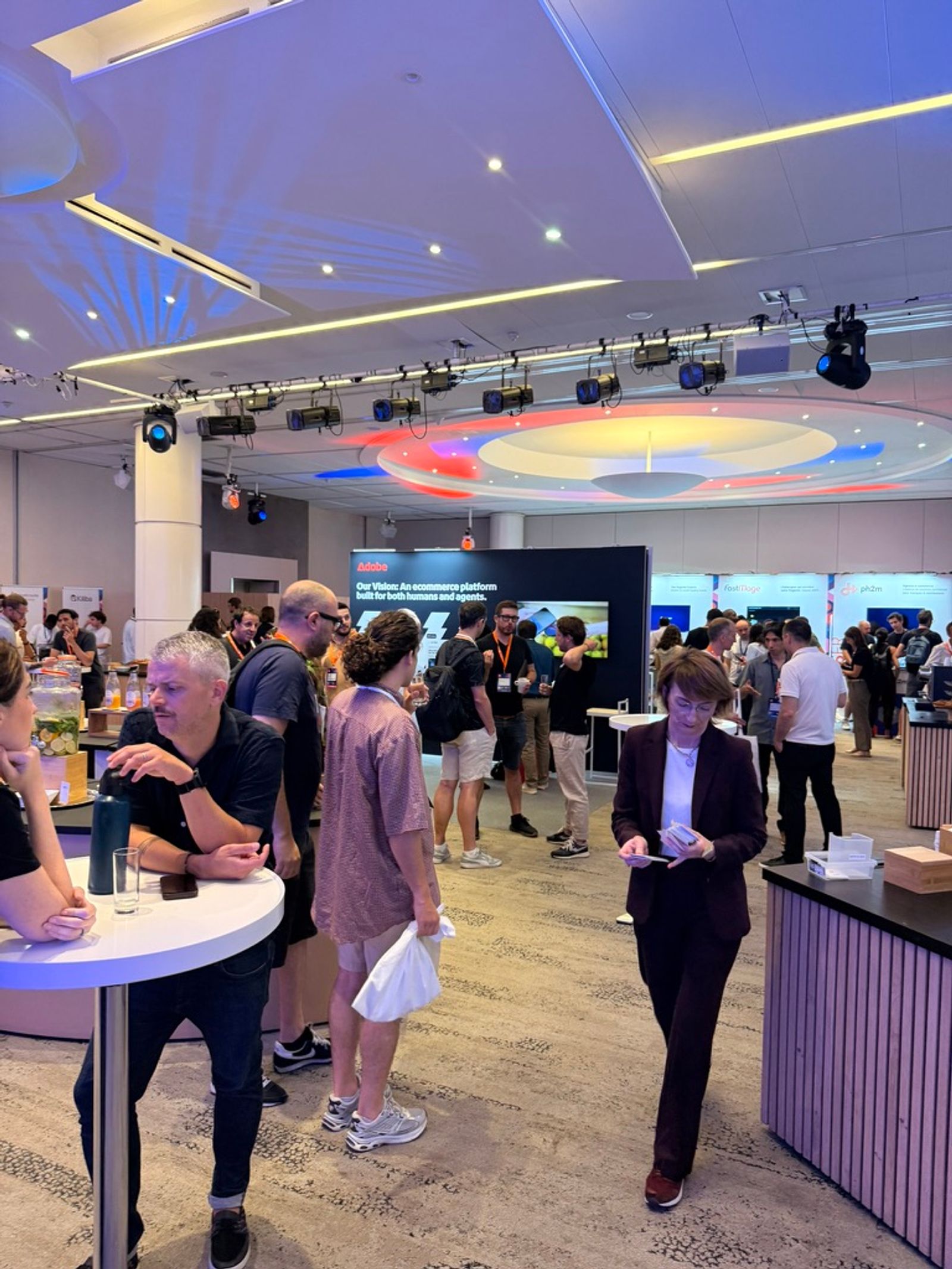
Meet Magento France 2026 was in Paris on 25 June, and the room was packed. Between the announcements, the hallway conversations, and a live POS demo that stopped several merchants in their tracks, there is plenty to work through.
Three days on, still buzzing.
Here is what actually mattered, and what a merchant should do about it before the noise dies down.
Uniwax Went From Lighthouse 4 to Lighthouse 73
Aurore Aoussi's session on Uniwax opened with numbers most eCommerce teams will never see in their careers.
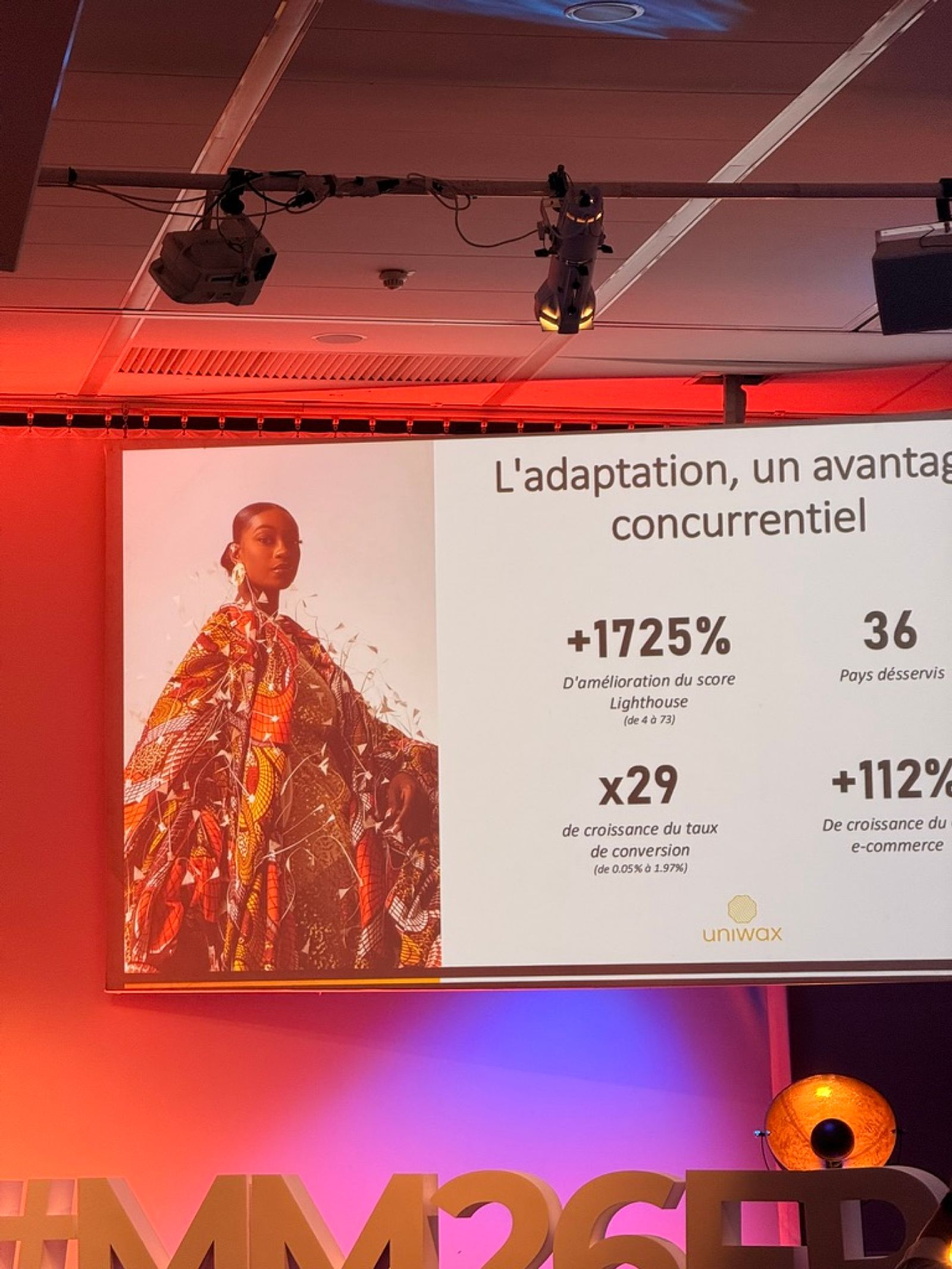
- Lighthouse score: 4 to 73 (+1725%)
- Conversion rate: 0.05% to 1.97% (that is 29x, not a lift)
- +112% eCommerce growth
- 36 countries served
The size of that conversion jump is the point. A 29x change is not an optimisation win. It is a different business. Whatever Uniwax was doing at 0.05% conversion was not a marketing failure, it was infrastructure. Once the site could hold a session and load a product page, the demand that was always there could finally convert.
For any store still telling itself its conversion problem is a marketing problem, this is the counter-argument. Fix the fundamentals first, then look at the funnel.
Romain Ruaud Reframed What a Search Bar Actually Is
The single quote most repeated after the conference came from Romain Ruaud's ElasticSuite session.
An internal search bar is a salesman. How do we turn an algorithm into an expert adviser?
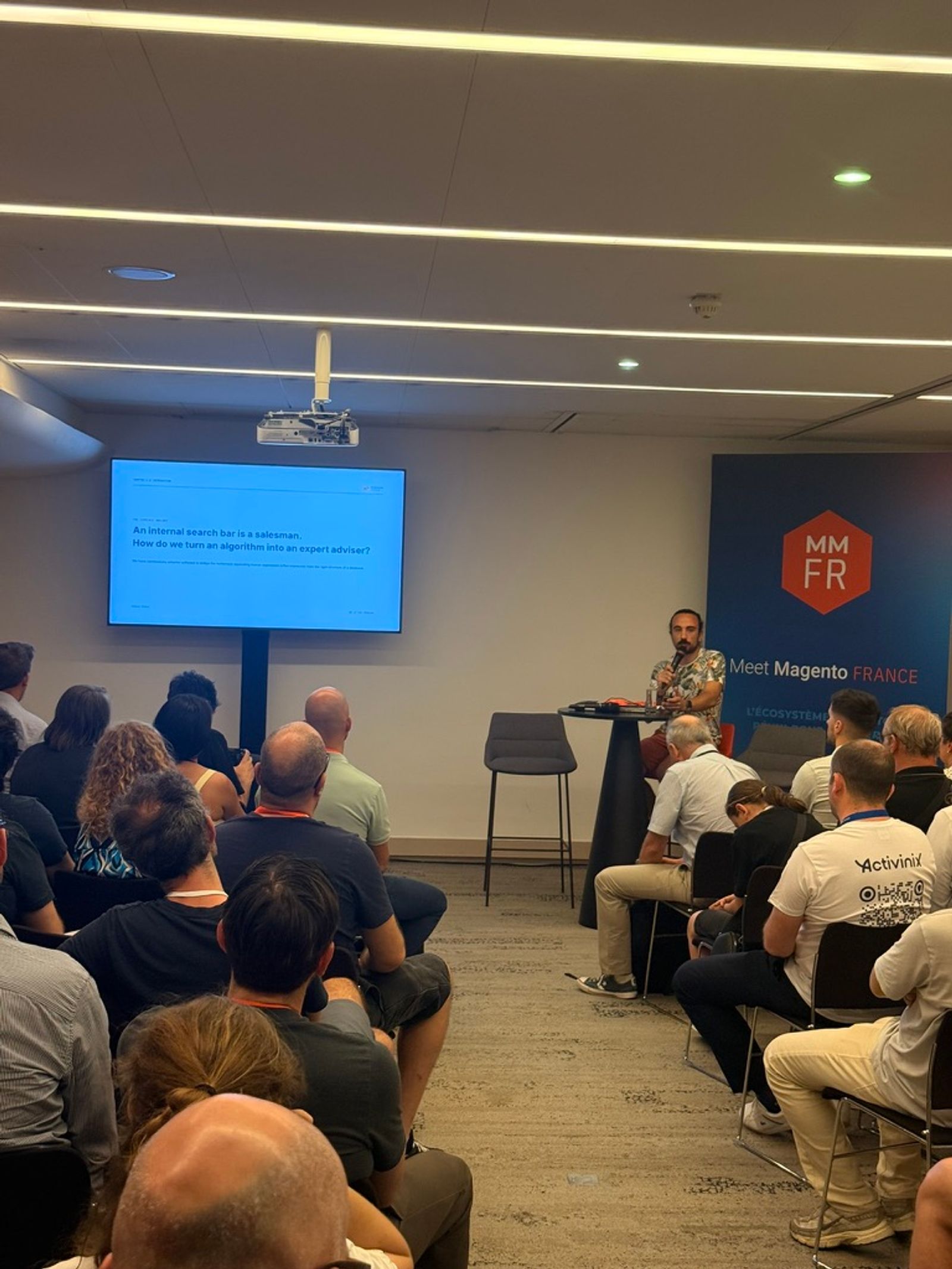
Search on most Magento stores is a text-matching tool. Type a word, get products that contain the word. That is not selling. That is filing. A good search behaves like a merchant who knows the catalogue, understands intent, and steers a shopper toward what they will actually buy.
Romain walked back through the history, starting with Stephen Robertson and Karen Spärck Jones at Cambridge in 1976, to show that the field has been solved and forgotten many times over. Most Magento stores are running search infrastructure whose theory is 50 years old and whose configuration was last touched at go-live.
The practical takeaway: open your search analytics this week. Look at the top 20 queries and what they return. If the answers are not the products you would show a customer standing in your shop asking the same question, that is a revenue leak, and it does not need a new platform to fix.
Somfy Retired the 'Magento Is Dying' Narrative in One Slide
The story that dominated eCommerce discourse for two years was that Magento is on the way out and every serious merchant should be looking at Shopify or headless. Somfy stepped on stage and quietly deleted that story.
Over 1.5 billion EUR in revenue. More than 90% B2B. Running on Magento.
Adobe's own keynote and Amasty's adoption data at Hyvä Developers Paradise 2026 said the same thing with different numbers. If you missed our DevParadise recap, the short version is that new Magento stores are being launched again and Hyvä adoption is rising sharply. Somfy is what that trend looks like at scale.
The merchants who quietly stayed on Magento while the noise was loudest are the ones who now have the largest lead. The platform did not fall behind. The narrative did.
Willem Wigman: Magento's Structure Is an AI Advantage
The closing keynote from Willem Wigman argued something worth sitting with.
Every platform is now scrambling to answer the same question: how do you let AI agents write code against a production storefront without breaking it. Most platforms are answering that by adding constraints. Magento already had them.
Willem's argument was that Magento's structured framework, its patterns, its dependency injection, its class hierarchy, all the things engineers used to complain were heavy, become exactly what an AI agent needs to generate code that works. A model with clear guardrails writes safer code than a model turned loose on a blank canvas.
This is why LIQUIDLAB now runs LIQUIDLAB AI™ inside its own workflows, from code analysis to deployments. Not as a novelty, as a production tool. The reason it works on Magento is exactly the reason Willem was making at the podium: the platform's structure is the model's safety net.
Ivan Chepurnyi Hit TTFB Under 150ms Without a Cache
Ivan Chepurnyi's session was the kind that reminds you why some engineers get called wizards.
TTFB under 150 milliseconds, on Magento, with no cache.
Not with Varnish in front. Not with a full-page cache. Raw application response, under 150ms. That is 100 times faster than the response times most Magento stores post on their product pages today.
The point is not that every store can hit this. The point is that the ceiling is much, much higher than most implementations reach. When a merchant sees a slow Magento store and concludes the platform is the problem, they are wrong. The platform can go this fast. The specific implementation is what is slow.
Ivan's TTFB number is the ceiling any optimisation argument should be measured against.
Vinai Kopp Showed How Hyvä Ships AI Safely in Its Own Team
Alongside Willem's closing, Vinai Kopp walked through how the Hyvä team is using AI agents and skills inside its own development workflow.
The interesting part was not the tools. It was the safety story. Hyvä is not letting agents write code and pushing it. It is using them as accelerators inside a workflow whose gates and reviews were already in place. The AI does the drafting. The engineer still owns the merge.
For any agency thinking about how to bring AI into a development team without creating chaos, this is a working template. Structure first, agents second. Not the other way around.
Maison Kitsuné at Year 3: What Long-Term Hyvä Looks Like
Most Hyvä case studies you find online are about the launch. Sophie Deleporte and Klauss Mortreux from Blackbird presented something more useful: what Maison Kitsuné looks like three years after the launch.
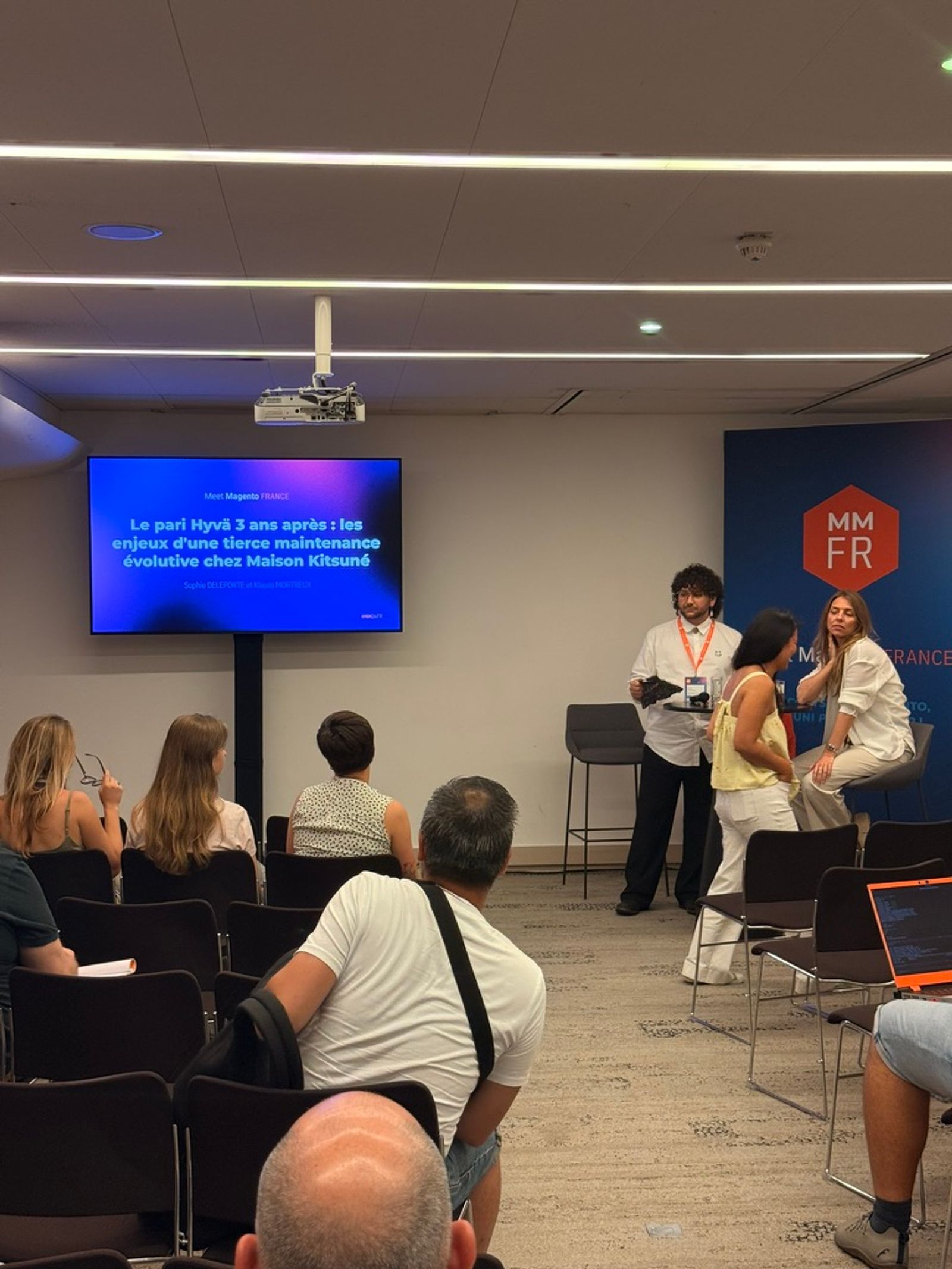
The reason this matters more than a launch story: any merchant considering Hyvä will hear plenty of 'we cut Time to Interactive by 60%' pitches. Fewer will hear what maintenance actually looks like once the marketing team is running promotions on it every week and the merchandising team is adding categories weekly. Year 3 is when the real questions show up: how does the frontend hold up under two years of feature additions, how much developer time does it still need, what does the team need to keep learning.
If you are quoted a Hyvä project this year, ask your prospective agency what year 3 looks like for their existing Hyvä clients. If they cannot answer, you are the year 3 test case.
The Adobe AI Numbers That Should Change Your Roadmap
Régis Quintin from Adobe Commerce opened the day with numbers on the AI shift in eCommerce.
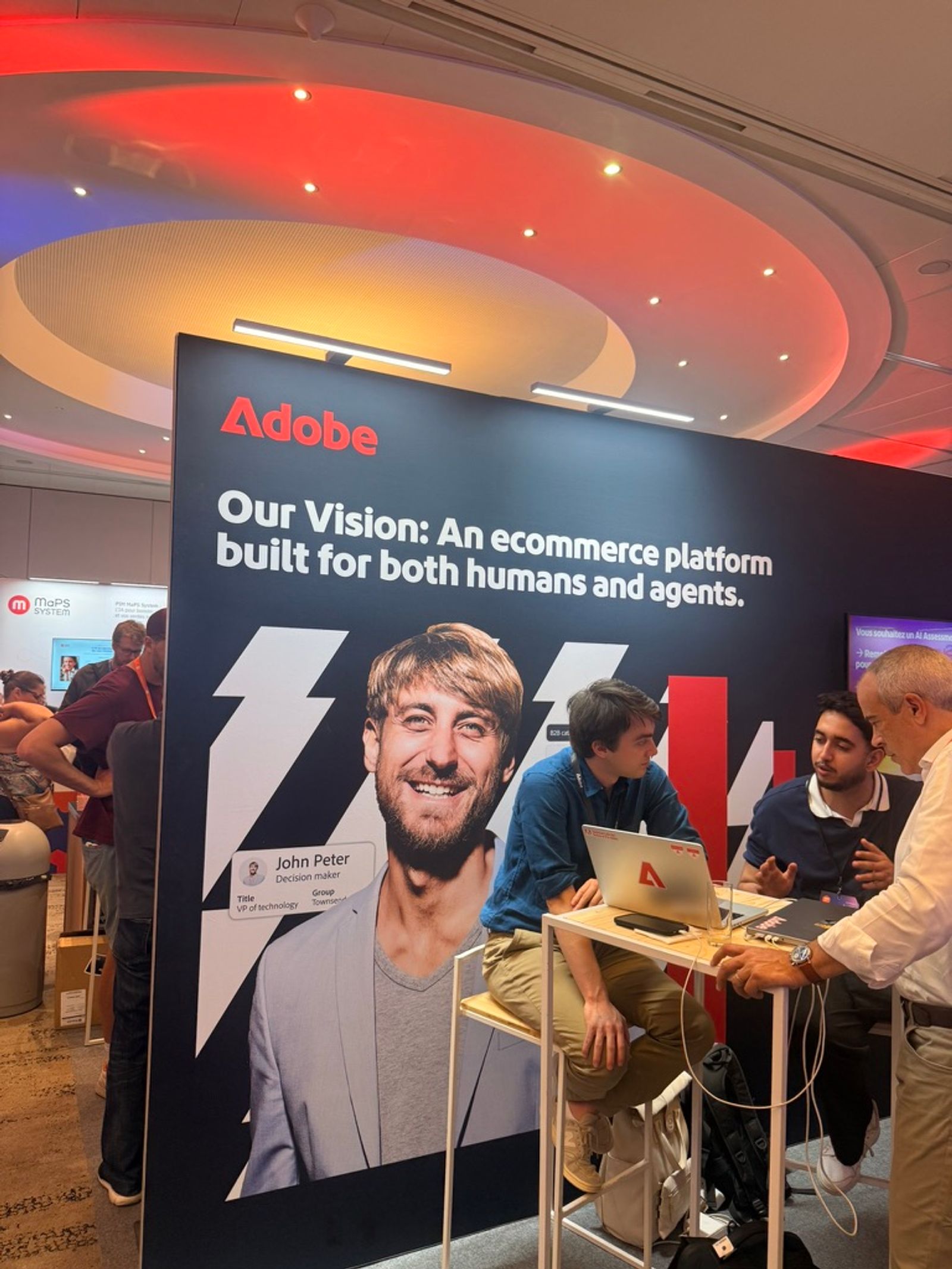
- 77% of shoppers already use GenAI for product research
- AI-driven visits: 254% more revenue per visit in the 2025 holiday season
- 32% higher conversion rate than other traffic sources
These are Adobe's own measurements across the Adobe Commerce base. They are not projections. They are what already happened last Christmas.
The read: the shopper who arrives at your site from a GenAI assistant is a fundamentally more valuable session than the one arriving from a Google click. If your store does not appear in the places assistants gather product information, you are missing the highest-converting traffic source of 2026, and the gap is compounding.
What Merchants Should Do This Week
Six things worth doing before Monday.
- Open your search analytics. Look at the top 20 queries. Ask whether the results would satisfy a customer standing in your shop.
- Ask what your TTFB is on a product page. If it is measured in seconds, the frontend is not the problem.
- Read the Somfy note above the next time someone tells you Magento is finished.
- Book time to think about how AI-assistant traffic reaches your catalogue. It is not the same as SEO.
- Ask a Hyvä agency to walk you through what a client's post-launch reality has looked like, not just the launch itself.
- If you are already on Hyvä and something is not adding up, the platform is almost never the problem. Get the codebase looked at properly.
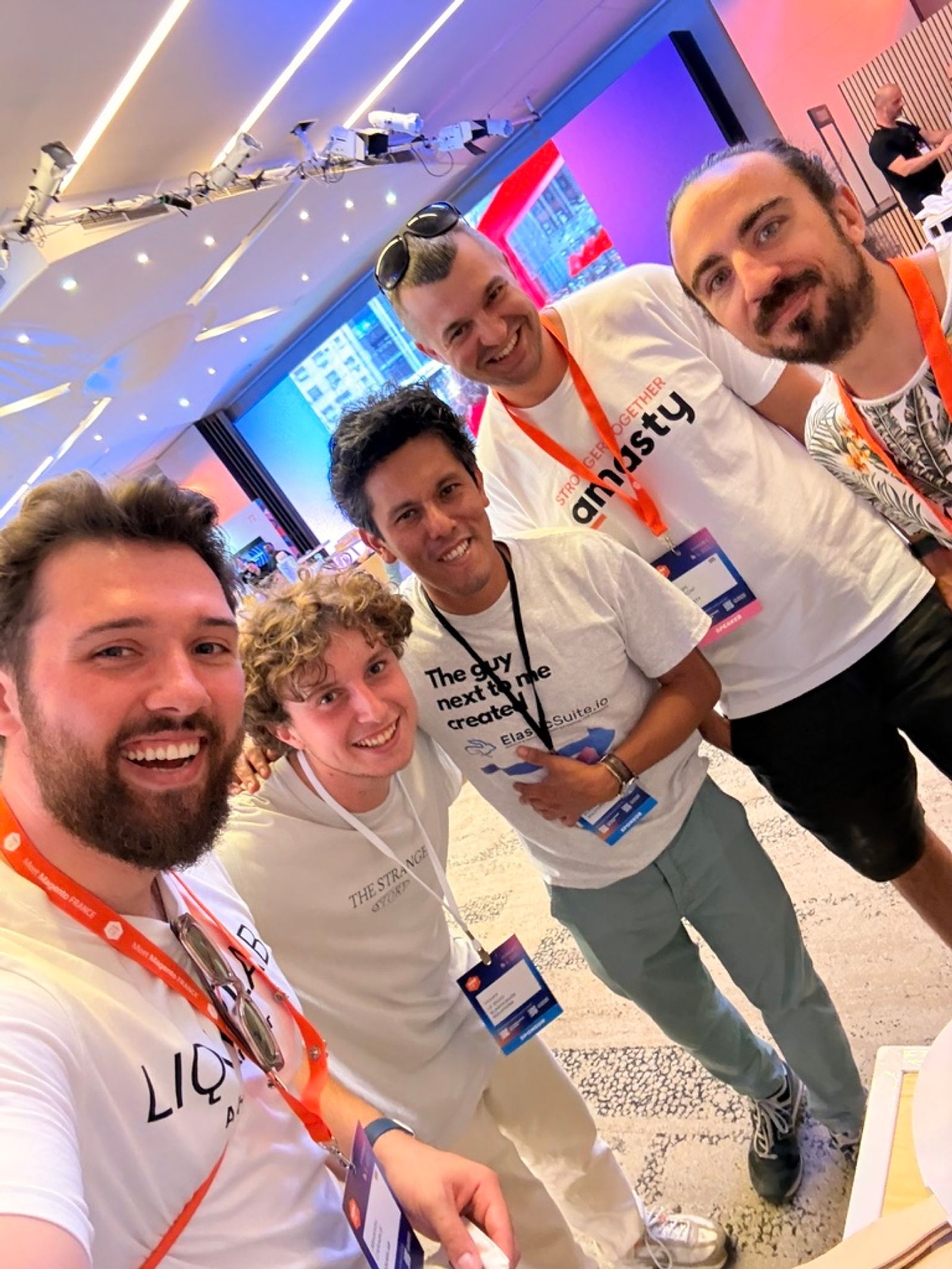
A sincere thank you to Opengento for organising, to Willem Wigman, Sergej Derzap, Romain Ruaud, Aurore Aoussi, Sophie Deleporte, Klauss Mortreux, Régis Quintin, Ivan Chepurnyi, Vinai Kopp, and every other speaker who made the room worth being in, and to Thien-Lan Weber and the Hyvä team for setting the tone of the day.
Want to know what these signals mean for your specific store? We offer a free strategy call for merchants who want a clear picture of what changing (or fixing) their setup would actually look like.