Guides
Five Questions to Ask Any Before-and-After Speed Claim
October 23, 2026 - by Alexandru-Manuel Carabus
Every agency shows a before and an after. Here are five questions that tell you whether a speed claim is real: which page, test visit or real users, which dates, guest or logged in, and what else changed. Plus where to check each answer yourself, for free.
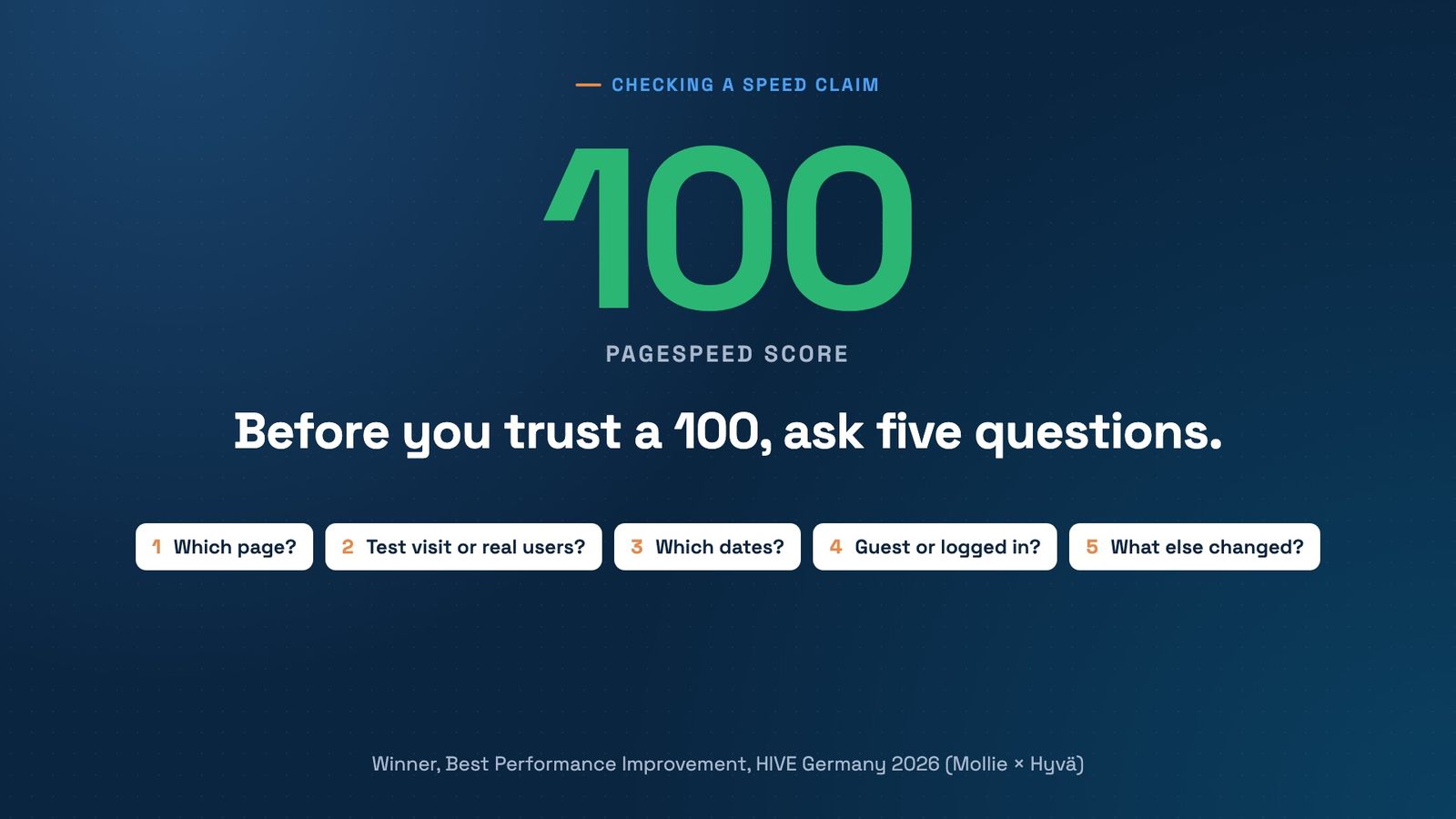
Since Best Performance Improvement at HIVE Germany 2026, the question we hear most is how to tell a real speed gain from a nice screenshot. Every agency shows a before and an after, ours included. A red 30 next to a green 100 looks like proof. It only becomes proof once you know what was measured, where, when and for whom.
Here are five questions to ask of any before-and-after, and where to check each answer yourself, for free.
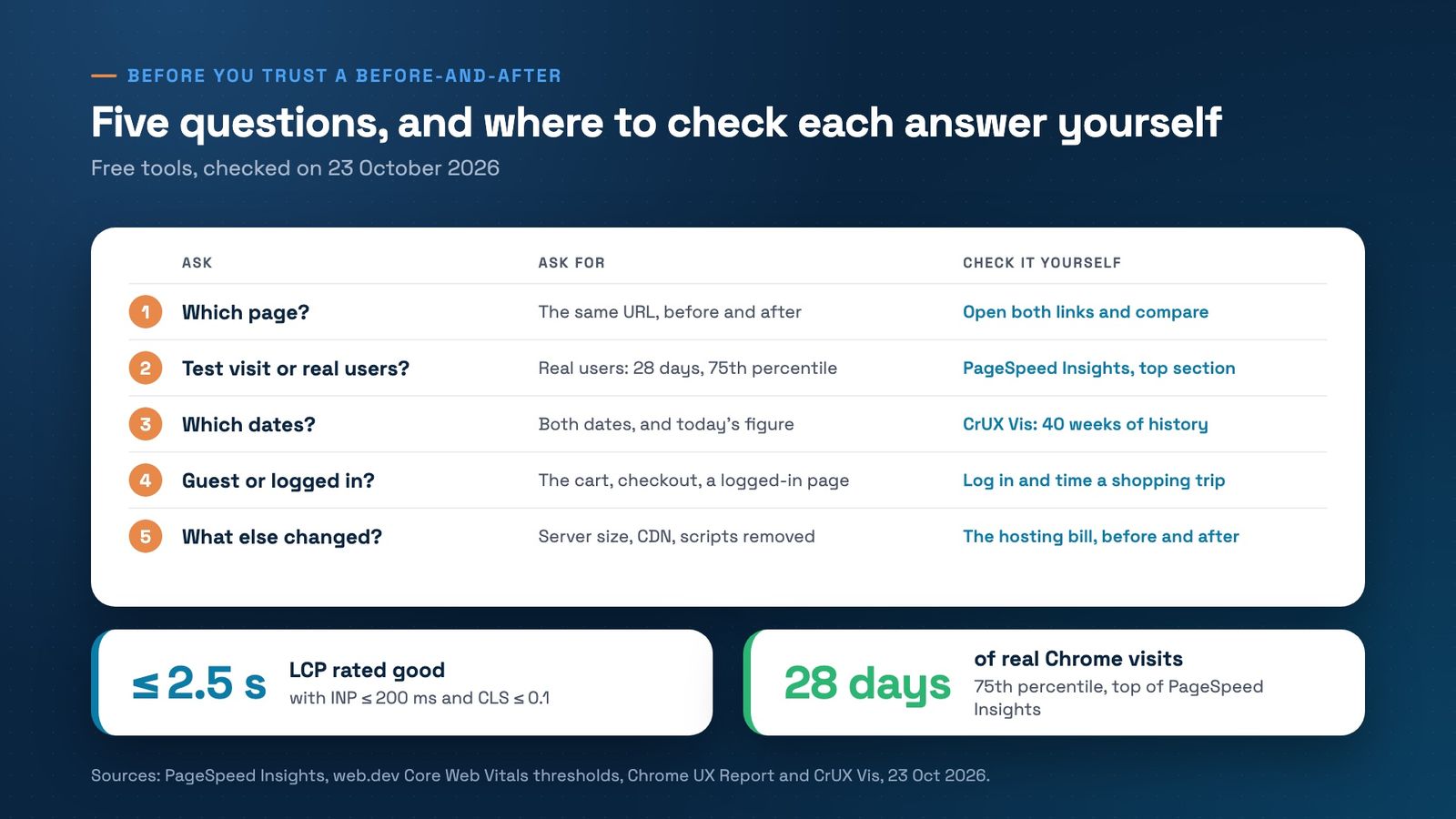
1. Which page?
A homepage, a category page and a product page do very different work. A before taken on the slowest page and an after on the fastest one can show a gain no shopper ever felt. Ask for the same URL, before and after. Two different pages compare two pages, not two versions of the store.
2. One test visit, or real users?
The big score in PageSpeed Insights comes from one visit by Google's test machine: an emulated mid-range phone, a Moto G Power, on a throttled Slow 4G connection, loading the page for the first time. Run it again and the score moves, even when nothing changed. Lighthouse, the engine behind it, says so itself and recommends the median of several runs: the median of 5 runs is twice as stable as one.
The section at the top of the same report is different. It's the Chrome UX Report: real Chrome visitors over the last 28 days, at the 75th percentile, which is the data Google uses for Core Web Vitals. A page is good when LCP is at most 2.5 s, INP at most 200 ms and CLS at most 0.1. We wrote more on the score versus real users.
A page with too few visits shows the whole site instead (the Origin tab), and a small store may have no real-user data at all. Then the claim rests on test visits alone, so ask for the median of several.
For scale: in HTTP Archive's September 2026 report, built on the same Chrome data, 66% of Hyvä stores passed Core Web Vitals on phones, against 45% of Magento stores overall.
3. Which dates, and is it still true?
A before from two years ago and an after from last week don't show one change. They show everything that happened in between. And an after from launch week says nothing about today. Ask for both dates. Then check CrUX Vis: it shows the last 40 weekly 28-day windows, about ten months, with no sign-in, for any site with enough Chrome traffic. A real change shows as a drop in the week it went live, and the line stays down.
4. Guest or logged in, cached or not?
PageSpeed's test visit arrives as a new guest: no login, an empty cart, nothing stored. On Magento that is often the page the cache already holds, the fastest case there is. The cart, the checkout and the customer account are never served from the full-page cache, and on many B2B stores custom prices keep a logged-in client's pages out of the cache too. Ask how fast those are, or time a shopping trip yourself, step by step.
5. What else changed?
Ask what moved at the same time: a bigger server, a new CDN, a removed tracking script, a lighter homepage, fewer products. Some of that is good work. A bigger server is just a bigger bill, and the speed goes when the traffic grows. The honest version names every change. At Vitacom, the server went the other way, from 64 cores to 8, while pages got faster.
One before-and-after, five answers
Here is one that answers all five. Equitana moved from Magento 1 to Magento 2 with Hyvä and the Liquid Framework at the end of August 2026.
- Which page: the whole site, www.equitana.ro, not one hand-picked URL.
- Test visit or real users: real Chrome users, at the 75th percentile.
- Which dates: 19 July to 15 August 2026, the last 28 days fully on Magento 1, against 30 August to 26 September 2026.
- Guest or logged in: real-user data counts every visitor, logged in or not.
- What else changed: the whole platform, so the claim is about the move, not one fix. How the move went.
The result: phone LCP from 4.2 s to 1.1 s, phone TTFB from 3.7 s to 0.34 s, and Core Web Vitals from failed to passed. INP was already good on Magento 1, so we don't claim it. Open CrUX Vis, type https://www.equitana.ro and you'll see the drop at the end of August.
Have a before-and-after you're not sure about, ours or anyone's? Book a free strategy call and bring it. We'll go through the five questions with you.
Get the next article in your inbox
One email a month with new articles, speed fixes and the Magento security patches worth applying.